
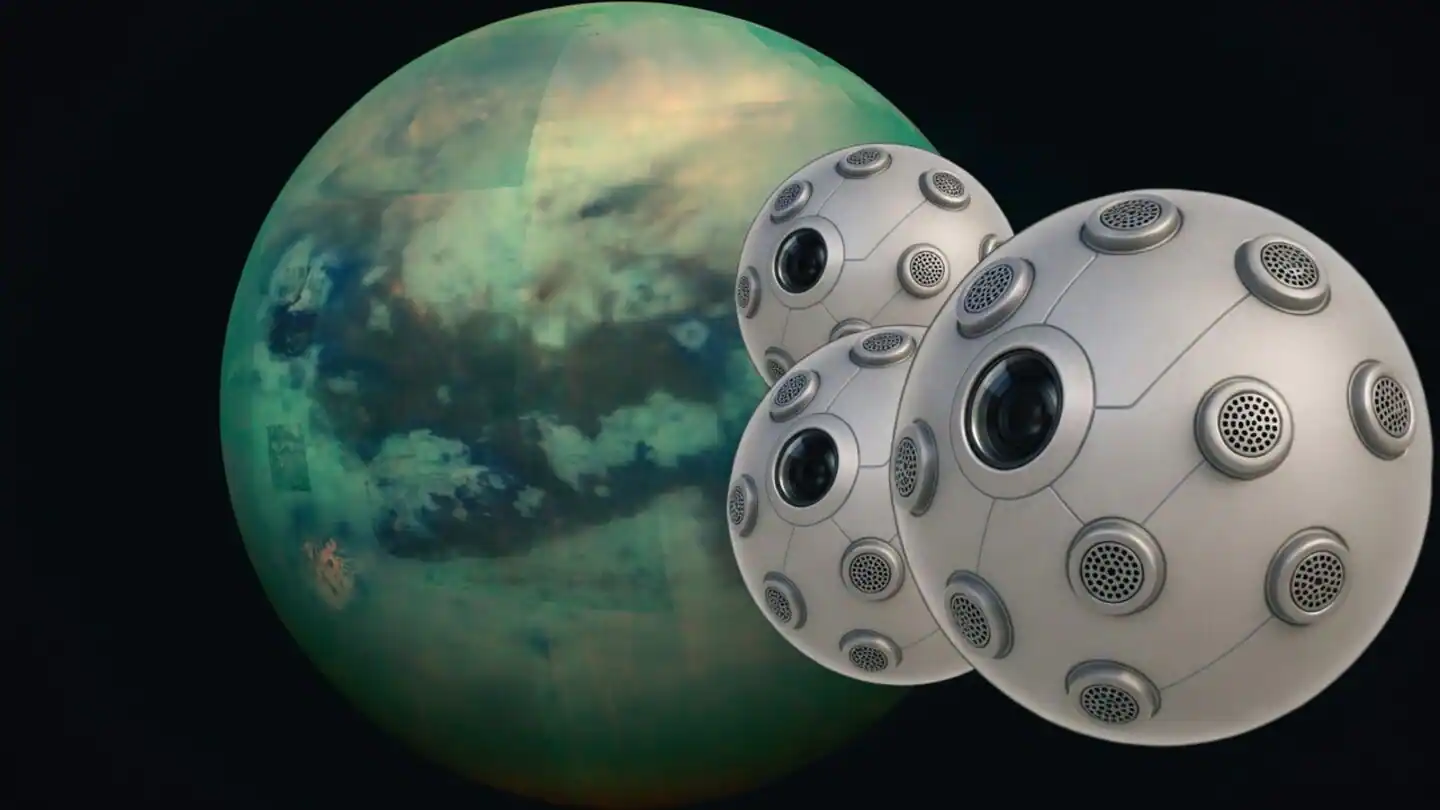
NASA has awarded early-stage funding for Titan aerobots designed to explore underground environments on Saturn’s largest moon. The experimental vehicles could eventually investigate caves and other difficult terrain that traditional rovers might struggle to navigate.
The project comes through NASA’s Innovative Advanced Concepts program, which supports early research into unconventional space technologies. Researchers will spend the initial funding period developing and evaluating the concept before seeking additional support.
University of Hawaii researcher Daniel Drew leads the project, known as SPARK. The name represents Solid-state Propulsion for Autonomous Reconnaissance of Karst, describing the project’s intended exploration environment.
Titan presents an unusual destination because its surface contains rivers, lakes, and seas filled with hydrocarbons. Scientists also believe the moon contains underground formations, including caves and sinkholes created within its unusual landscape.
Consequently, researchers see flying robots as potentially better suited for certain locations than traditional wheeled spacecraft. Small aerial vehicles could potentially enter narrow passages while gathering information from environments that prove difficult for larger machines.
The SPARK concept uses electrohydrodynamic propulsion, commonly known as EHD propulsion, to generate movement. Unlike conventional aircraft systems, the technology uses electrical forces rather than traditional rotating components.
Drew has studied this propulsion approach for years while developing small flying machines and experimental ion-powered devices. His previous research included micro-scale vehicles that demonstrated flight using atmospheric ion propulsion.
Now, the NASA-supported project will examine whether the technology can operate effectively under Titan’s extreme environmental conditions. The moon experiences exceptionally cold temperatures that could create significant challenges for electronics, power systems, and mechanical components.
The research team believes EHD propulsion could offer several advantages for future exploration missions. For example, the system contains relatively few moving parts, which could simplify maintenance and improve mechanical reliability.
Additionally, the propulsion method operates quietly and could potentially support repeated flights inside underground environments. Therefore, researchers see opportunities for persistent exploration rather than relying on one short aerial survey.
However, the technology also faces significant limitations that researchers must address during development. EHD propulsion currently remains considerably less efficient than conventional propulsion systems used by aircraft and drones.
As a result, the researchers do not expect the technology to replace conventional aircraft propulsion across most Earth-based applications. Instead, the team sees specialized environments such as Titan as potentially more suitable for the concept.
The project could eventually complement NASA’s Dragonfly mission, which aims to investigate Titan using a larger rotorcraft. However, the current development schedule may not align with Dragonfly’s planned launch timeframe.
The initial SPARK study will last approximately nine months, giving researchers limited time to evaluate major technical questions. A potential second development phase could then provide additional time for more advanced testing and analysis.
During the first phase, researchers plan to examine several critical systems and determine which technologies require further development. They will also study power requirements and thermal effects that could influence performance on Titan.
Furthermore, the team expects to conduct detailed comparisons between different subsystem designs. These studies should help researchers identify practical approaches for creating an operational spacecraft capable of surviving Titan’s challenging environment.
The researchers also see possible applications beyond Saturn’s moon if the propulsion technology continues improving. Potential uses include miniature drones, indoor flying machines, and small autonomous aerial swarms.
Nevertheless, efficiency remains one of the largest obstacles facing broader adoption of EHD propulsion. Significant improvements would likely become necessary before the technology could compete with conventional rotors or jet engines.
For now, Titan aerobots remain an experimental concept rather than a confirmed spacecraft mission. NASA’s funding will allow researchers to determine whether the technology can progress toward realistic planetary exploration applications.
If development succeeds, these small vehicles could eventually provide scientists with access to previously difficult underground environments. Moreover, their compact design could complement larger spacecraft by investigating locations that conventional vehicles cannot easily reach.
The research demonstrates NASA’s continued interest in unconventional technologies for future planetary exploration. Meanwhile, the SPARK project could provide valuable data about electric propulsion and autonomous flight in extreme environments.

