
Temporary Protected Status has become the focus of renewed immigration debate after recent federal actions and a Supreme Court ruling affected humanitarian protections for hundreds of thousands of migrants living in the United States.
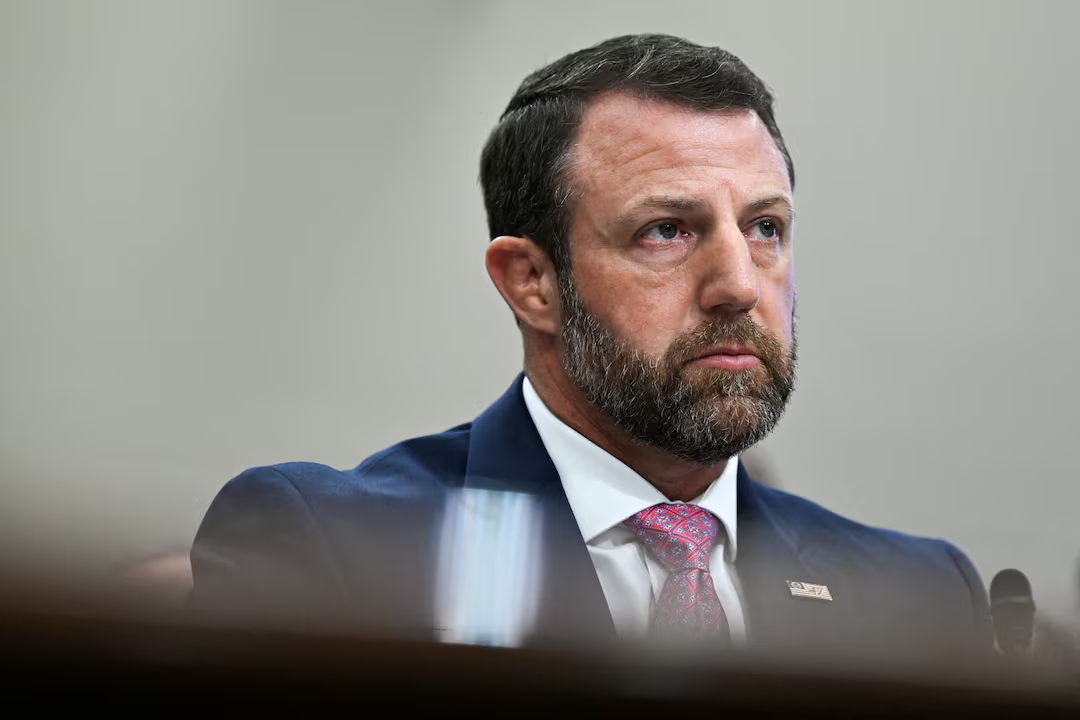
Homeland Security Secretary Markwayne Mullin said migrants currently protected under Temporary Protected Status should seek permanent legal residency if they qualify. Otherwise, they should prepare to leave the country. During a televised interview, Mullin said the administration would help people return home if they no longer qualified for the temporary program.
Mullin encouraged eligible migrants to complete the paperwork required to obtain permanent legal status. He also said the government would provide airfare and about $2,100 to help individuals reestablish themselves after returning to their home countries.
He emphasized that the Temporary Protected Status program serves as a temporary humanitarian measure rather than a permanent immigration pathway. Mullin said both the law and the program’s name clearly reflect its temporary purpose.
The comments followed a recent Supreme Court ruling that removed humanitarian protections from large groups of Haitian and Syrian migrants. The decision could allow the administration to begin deportation proceedings against people whose protections have expired.
Federal law allows the executive branch to grant Temporary Protected Status to foreign nationals. The program protects people fleeing armed conflict, natural disasters, or other extraordinary conditions in their home countries.
The United States first granted these protections to Haitian nationals after the devastating 2010 earthquake. The government later extended the program to Syrian nationals after civil war erupted in Syria during 2012.
Despite the legal changes, the U.S. State Department continues advising Americans not to travel to Haiti or Syria. Current travel guidance cites violence, crime, terrorism, kidnapping, and unstable conditions in both countries.
The Supreme Court ruling is expected to affect about 350,000 Haitian nationals and roughly 6,000 Syrian nationals. As their protections expire, Immigration and Customs Enforcement could detain affected individuals or begin deportation proceedings against them.
Many Haitian beneficiaries and immigration advocates criticized the decision. They argued it could disrupt families and communities built over many years. They also noted that many recipients have lived and worked legally in the United States through repeated renewals of the humanitarian program.
Residents in Haitian communities also expressed concern about the practical effects of ending the protections. Business owners and community members warned that local economies and neighborhoods could suffer if longtime residents leave the country.
The Supreme Court’s majority concluded that the legal challenge filed by Haitian plaintiffs was unlikely to succeed. The court also rejected claims that the administration acted with racial bias.
Not all Republican officials supported ending the protections. Ohio Governor Mike DeWine called the ruling a mistake. He cited Haiti’s ongoing instability, widespread gang violence, limited government authority, and severe economic hardship.
Republican Representatives Mike Lawler of New York and Don Bacon of Nebraska also supported extending Temporary Protected Status for Haitian nationals.
Government data show that about 1.7 million people from 17 countries currently receive protection through Temporary Protected Status. Immigration organizations warned that future policy changes could affect additional nationalities covered by the humanitarian initiative established in 1990.
States have adopted different approaches to immigration enforcement. Several Republican-led states expanded cooperation with federal authorities. Meanwhile, several Democratic-led states enacted measures limiting cooperation in certain immigration enforcement activities.
At the federal level, the administration has increased enforcement of a longstanding legal requirement directing certain noncitizens to register with the U.S. government.
The future of Temporary Protected Status will continue attracting national attention as legal, political, and humanitarian debates evolve. Federal officials, lawmakers, affected communities, and advocacy organizations will continue monitoring the program closely following the court’s decision.

