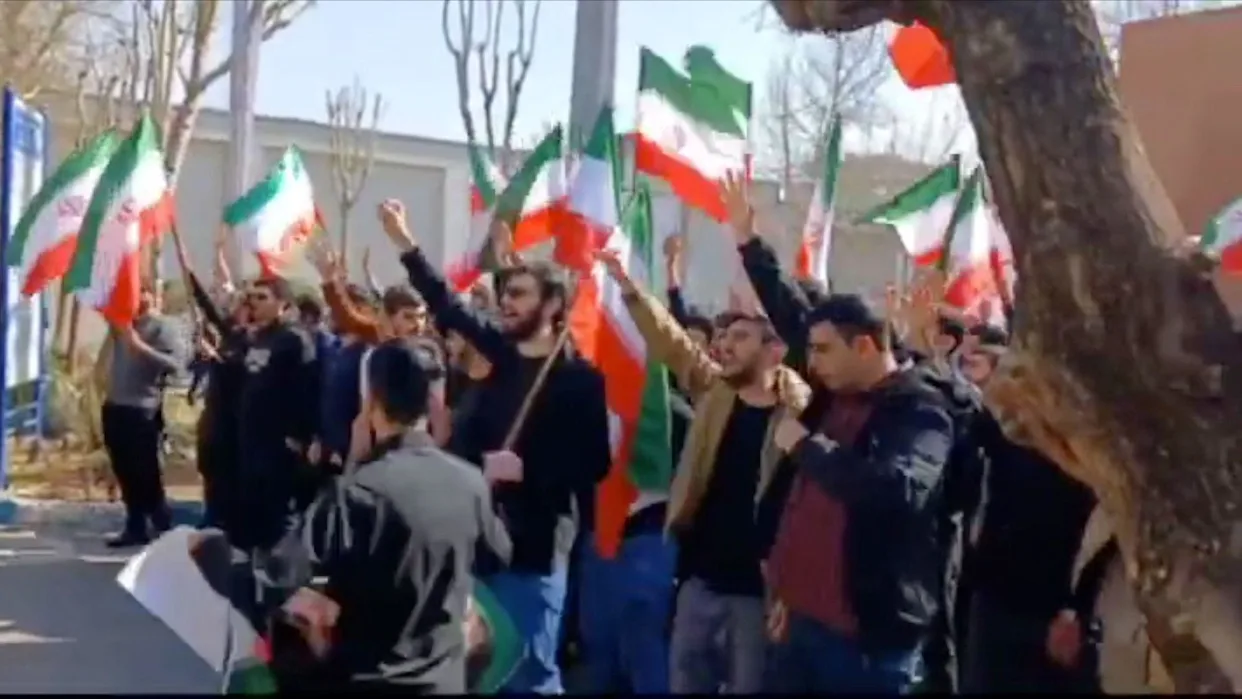
Iran student protests have erupted across major universities following last month’s deadly nationwide crackdown. Demonstrators gathered in Tehran and other cities, signaling renewed unrest despite heavy security pressure. The rallies mark the first large-scale campus mobilizations since authorities suppressed January’s mass demonstrations.
Students marched at Sharif University of Technology in Tehran at the start of the new semester. Videos show hundreds walking peacefully while holding Iranian national flags and chanting slogans. Protesters shouted “death to the dictator,” directly criticizing Supreme Leader Ayatollah Ali Khamenei.
Meanwhile, pro-government supporters assembled nearby, creating tense scenes across the campus grounds. Scuffles broke out between opposing groups as security forces monitored developments closely. Authorities have not confirmed whether they detained participants during Saturday’s confrontations.
In addition, students organized a peaceful sit-in at Shahid Beheshti University in the capital. Footage also captured chanting crowds at Amir Kabir University of Technology. Demonstrations extended beyond Tehran into Mashhad, Iran’s second-largest city in the northeast.
There, students reportedly chanted for freedom and demanded protection of their rights. Organizers circulated calls for additional rallies on Sunday through social media networks. Consequently, Iran student protests appeared coordinated across several academic institutions nationwide.
Last month’s unrest began with economic grievances before expanding into wider political opposition. Activists described it as the largest protest movement since the 1979 Islamic Revolution. The US-based Human Rights Activists News Agency reported thousands of deaths during that crackdown.
According to Hrana, more than 6,000 people died, including protesters and children. Iranian officials disputed those figures and stated that many victims were security personnel. Authorities accused rioters of attacking officers and civilians during chaotic confrontations.
At the same time, geopolitical tensions continue influencing the domestic political climate. The United States has increased its military presence near Iranian territory. President Donald Trump recently stated that he may consider limited military action.
However, American and Iranian officials met in Switzerland this week for nuclear discussions. Both sides reported progress in efforts to curb Iran’s nuclear program. Nevertheless, Trump indicated that the coming days would determine whether diplomacy succeeds.
Exiled opposition groups have urged Washington to take decisive action against Tehran’s leadership. Conversely, other activists reject foreign intervention and warn against external escalation. As divisions deepen, Iran student protests highlight mounting pressure on authorities from within society.